What Is Elephant Enrichment?
Elephant enrichment is not a buzzword. It’s the science—and the art—of giving elephants back the freedom to choose, explore, and express who they really are. Here’s how it works at Khaolak Elephant Sanctuary, and why it matters for every traveler who cares about animal welfare.
Why Enrichment Exists
In the wild, elephants spend most of their day foraging, navigating social dynamics, solving problems, and moving through changing landscapes. In captivity or semi-captive care—even at the best sanctuaries— the environment can be safer but more predictable. Without thoughtful design, that predictability turns into boredom, frustration, and stereotypic behaviors (like weaving or head-bobbing). Enrichment exists to restore complexity: to bring back the challenges, choices, and stimulation that nature provides.
Think of enrichment as a toolkit. It blends habitat design, food strategies, sensory experiences, and social opportunities to support an elephant’s mental and physical health. At Khaolak Elephant Sanctuary (KES), it’s the backbone of how we plan each day—quietly shaping where elephants can walk, what they can discover, and when they decide to do it. There’s no showtime, no whistle, no queue of guests with buckets. Just elephants making decisions, while visitors step back and observe.
What Enrichment Is (and Isn’t)
Enrichment is not a gimmick or a quick “activity” for humans. It’s a welfare framework that promotes choice, control, and competence. The best enrichment builds skills: foraging, problem-solving, navigating terrain, and social communication. The outcome isn’t a photo-op; it’s a calmer, healthier, more confident elephant.
- Enrichment is designing landscapes that invite exploration and foraging.
- Enrichment is scattering food and hanging browse at different heights to encourage natural feeding.
- Enrichment is letting elephants choose when to splash, dust, or mud themselves—without staging.
- Enrichment is not forcing elephants into the river on cue for tourist bathing.
- Enrichment is not lining up feed buckets so elephants perform for treats.
Core Types of Enrichment We Use at KES
Every sanctuary adapts enrichment to its elephants and its land. On our 20-rai site near Sai Rung Waterfall, we focus on strategies that reward curiosity and movement—without stress. Here are the pillars we rely on:
1) Foraging & Feeding Design
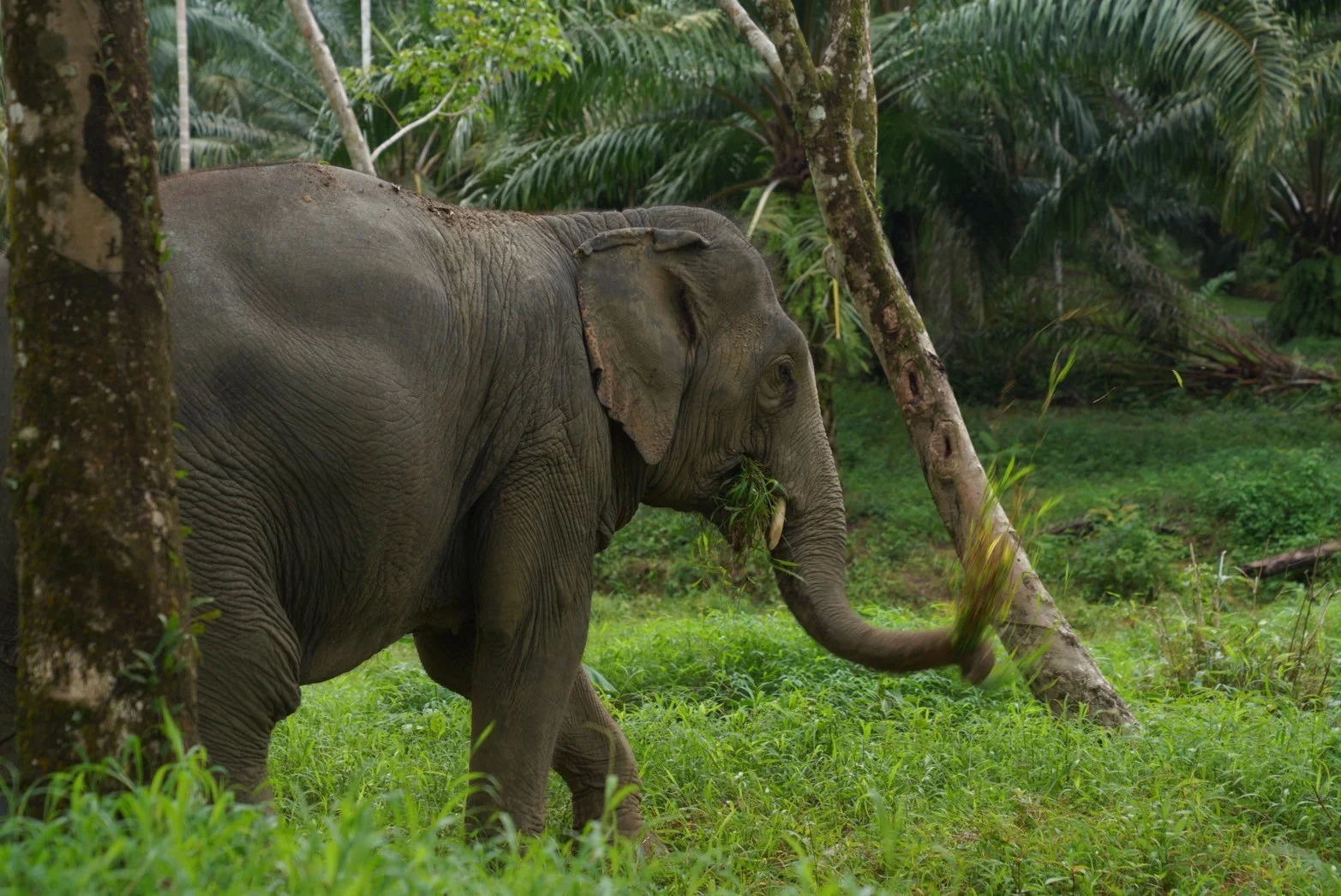
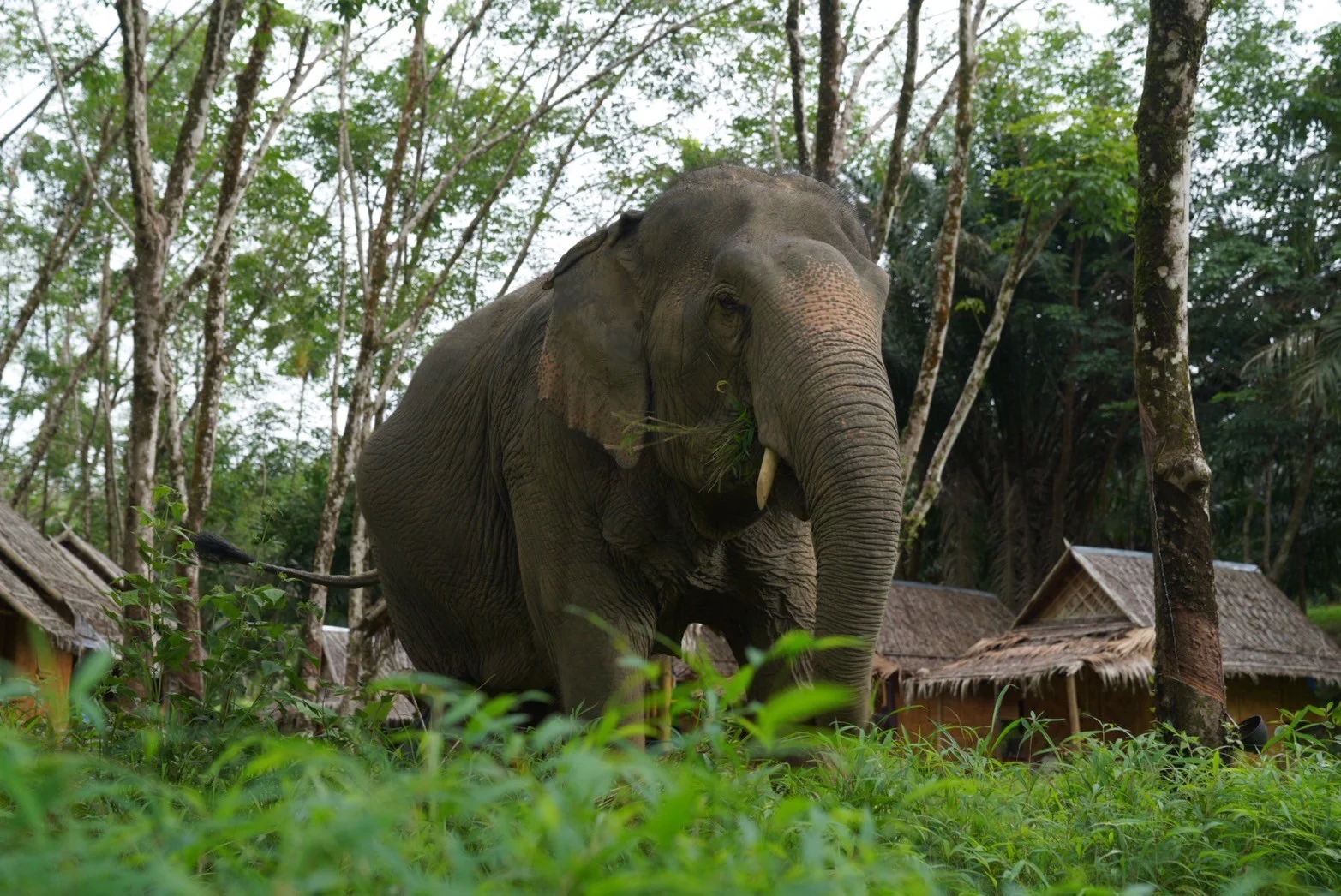
In nature, elephants spend up to 16–18 hours feeding. We mimic this rhythm by spreading browse piles, tucking banana stems among shrubs, and hanging fodder at different heights to activate trunk reach and stretching. Sometimes we hide treats inside natural materials—like weaving stalks through branches— so the search becomes as satisfying as the reward. The goal isn’t to make food “hard” but “interesting.”
2) Terrain & Movement
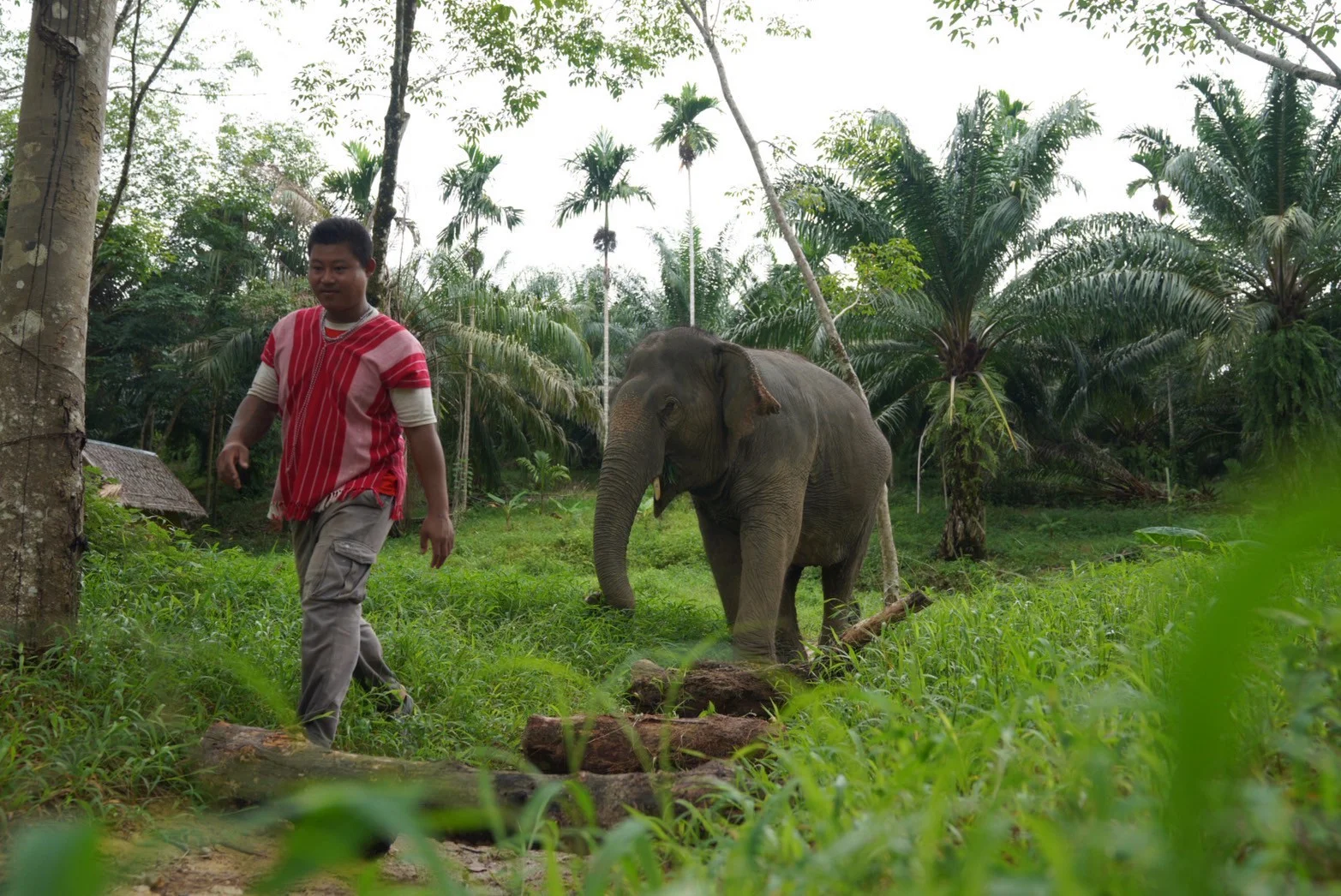
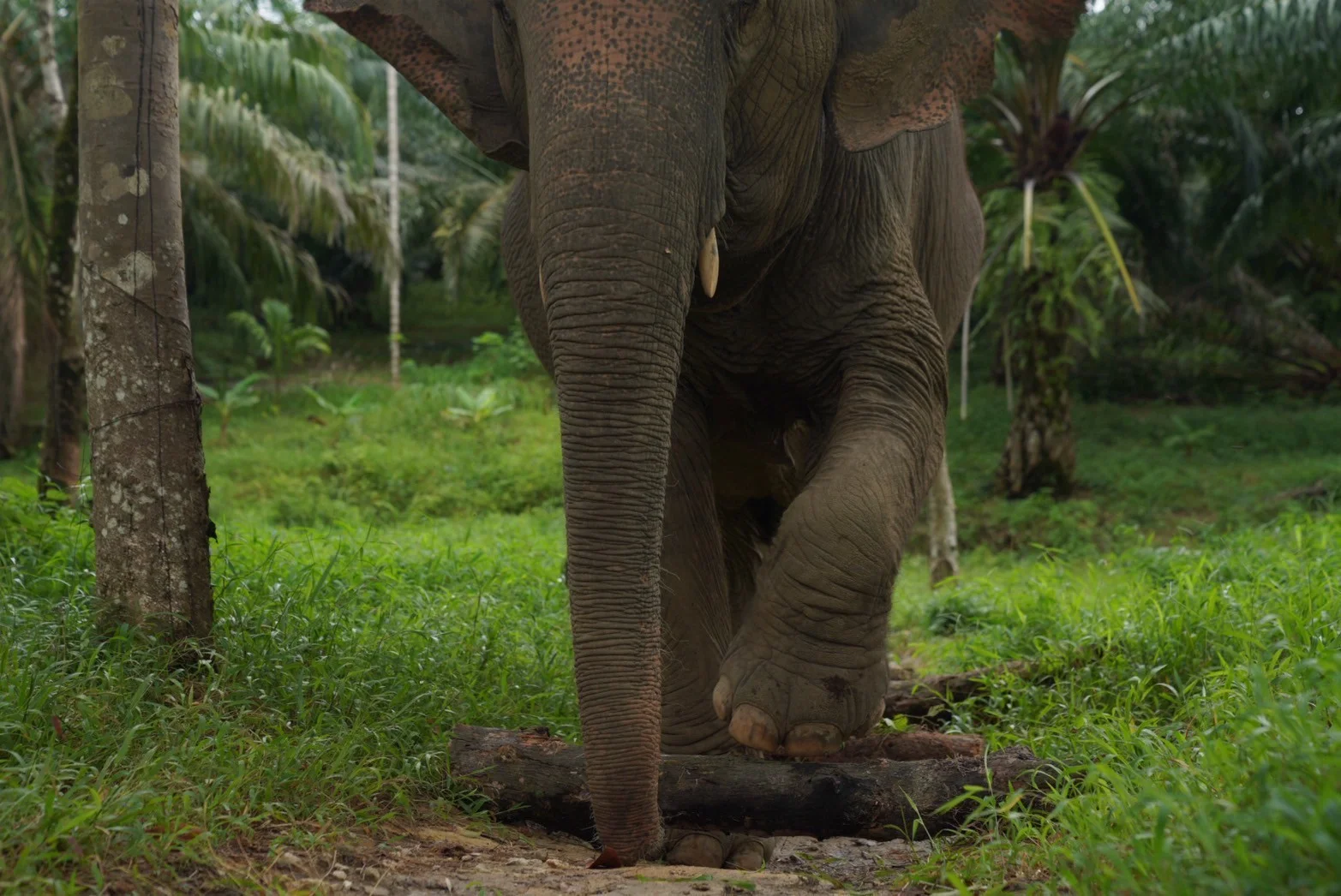
Flat ground is easy; varied ground is enriching. We keep pathways uneven and natural—soft soil, gentle slopes, shaded corridors, and open patches. Logs become balance beams; fallen trees turn into scratch posts. Moving through this mosaic recruits muscle groups, lubricates joints, and lets each elephant pick the route that feels good that day.
3) Water & Mud (On Their Terms)
Mud is sunscreen, skincare, and pure joy. Our water points and wallows are available daily—but never on a schedule for people. When the herd feels like it, they’ll dunk, roll, and spray. You might see it. You might not. That uncertainty is the proof it’s genuine, not staged.
4) Sensory Play & Novelty
Elephants experience the world through touch, smell, and low-frequency sound. We rotate natural scents (leaf piles, branches, bark), add safe textures (coarse logs, bamboo), and occasionally introduce novelty items made from natural materials. The key is rotation—today’s curiosity becomes tomorrow’s furniture unless we keep it fresh.
5) Social Choice
The most powerful enrichment is often social. Being near preferred companions, avoiding others when needed, greeting, rumbling, or simply dozing in proximity—these are the moments that stabilize nervous systems. We respect elephants’ preferences and maintain space so individuals can approach or withdraw freely.
How Visitors Fit In (Without Getting in the Way)
Enrichment thrives in quiet. That’s why we limit groups to 5 guests. Smaller groups lower pressure, reduce noise, and make sightings more intimate—ironically giving travelers better experiences by doing less. Your role is to watch, listen, and learn. The less you intervene, the more you see authentic behavior: trunk-to-trunk greetings, mud-sprays, gentle dominance, cooperative foraging.
Travelers used to “hands-on” elephant activities might feel uncertain at first. But enrichment is the opposite of performance—there is no script, so every minute is unique. When elephants choose to splash or dust right in front of you, that moment is earned—not engineered.
A Day of Enrichment at KES (Example Rhythm)
While elephants set the pace, this is a realistic snapshot of what guests often witness:
- Sunrise: Soft rumbles, slow foraging along the forest edge; trunks reaching for dew-wet grass.
- Morning: Browse scattered through shrubs; banana stems wedged between branches to encourage trunk strength.
- Late Morning: Social time near shade: ear-flaps, trunk touches, quiet naps, and sand-dusting.
- Afternoon: Self-chosen mud bathing when heat peaks; some individuals roll, others just splash.
- Evening: Calm grazing and long, unhurried walks; silhouettes framed by jungle light.
Why We No Longer Offer Guest Feeding or Bathing
It’s tempting to think that feeding and bathing are “enrichment,” but they usually shape elephants around tourist schedules rather than natural rhythms. Repeated feeding sessions can cause anticipation stress and push dominant elephants to crowd others. Daily “bathing with tourists” turns a self-care behavior into performance. By removing these, we restore autonomy. If an elephant chooses water, it’s real. If she forages for 40 minutes without looking up, that’s freedom.
The Science Behind Enrichment
Welfare science looks for reduced stereotypies, healthier weight, good foot and skin condition, normal social behaviors, and responsive curiosity. Enrichment helps on all fronts. Complex feeding lowers stress. Varied terrain improves musculoskeletal health. Social choice stabilizes heart rate and behavior. Visitors often notice it without knowing the science: “They look calmer here.” That calm isn’t an accident—it’s design.
Enrichment & Community: Two Halves of One Idea
Ethical care doesn’t end at the fence. A genuine program supports the people who make it possible: local mahouts, guides, and farmers. At KES, our 20 staff are hired from the Khao Lak area; the elephants’ diet—bananas, grass, sugarcane—comes from nearby producers. Enrichment is a daily practice, but it’s also a circular economy: your visit pays fair wages and funnels income back to local families.
What You’ll Gain as a Traveler
Enrichment flips the script. Instead of “doing something” to elephants, you learn to read them. You’ll notice trunk dexterity, ear language, and the quiet choreography of a herd negotiating space. You’ll leave with fewer selfies, more stories—and a sharper understanding of what respect looks like.
Photography & Timing Tips
- Golden hour: Late afternoon light is magic for silhouettes and dust clouds.
- Lenses: A versatile zoom (e.g., 24–105mm) keeps you flexible without stepping closer.
- Approach: Shoot from stable positions; avoid sudden movements that change elephant behavior.
- Mindset: Wait for the unscripted moment. Enrichment is best when you let it unfold.
Common Myths About Enrichment
- Myth: “If I can’t touch or bathe an elephant, it’s not worth it.”
Reality: The most meaningful moments are unscripted. Observation-first gives you truth, not theater. - Myth: “Enrichment equals toys.”
Reality: The best enrichment is habitat, food strategy, and social choice—nature is the “toy.” - Myth: “More tourists = better care.”
Reality: Crowds increase stress. Small groups protect welfare and deepen your experience.
How You Can Support Enrichment
Choose observation-led sanctuaries. Respect distance guidelines. Keep voices low. Book small-group programs. If you want to do more, consider supporting food costs—an elephant eats hundreds of kilos daily—or donating to education projects that help shift public expectations away from riding and shows. Vote with your wallet.
Why KES Keeps It Small (Max 5 Guests)
Big groups feel efficient on paper and chaotic in practice. With five guests, elephants stay relaxed, interactions remain authentic, and guides can share deeper knowledge. You’ll learn more, and the herd stays undisturbed. Everyone wins.
Final Thought: Enrichment Is a Promise
At Khaolak Elephant Sanctuary, enrichment is a promise to the elephants—and to you. We promise to build days where they choose what happens next. We promise to keep groups small, keep practices transparent, and keep improving. And we promise that your presence won’t turn their lives into a performance. That’s what ethical travel looks like when you zoom in: quiet, patient, transformative.
Is enrichment the same as a show?
No. Enrichment supports natural behavior without schedules or cues. Shows are staged for people; enrichment is designed for elephants.
Will I definitely see mud bathing?
Maybe. Authentic behaviors aren’t guaranteed. If you see it, it’s because elephants chose it—which is exactly the point.
Why can’t I feed or bathe elephants?
Those activities create dependency and performance patterns. We protect autonomy instead—so behaviors remain natural.